Wednesday, February 27, 2008
Holding down the grocery budget


Friday, February 15, 2008
Critics' Notes: Small Plates and Service
In Seattle, where I work as a restaurant critic, as well as the whole length of the West Coast, small-plates dining has outlasted both faddishness and trend fatigue to become a permanent change in the way we dine out. Most of the new restaurants I’ve reviewed this year no longer divide their menus into starters and entrees. Now it’s “pizzette, crudi, and big plates,” or something even more ethereal like “tossed, crisped, and sparked” (still can’t figure that one out). Most of this year’s new bistros omitted divisions altogether, democratically listing $7 dishes between $16 ones for no clear reason. Ask the server how to put together a meal, and 95 percent of the time, the answer is “However you like.”
As an ADD eater who’s tired of making my way through a 20-ounce pork chop sitting on a liter of mashed potatoes, I am all for the small-plates cultural shift. My problem is that, by and large, service has still not caught up with it.
Restaurateurs and diners both like to talk about how small-plates dining is more casual. But when you tally up the check at the end of the meal, it’s not much cheaper -- and in my experience, it requires servers to be more, not less, attentive to their tables.
I can’t tell you how many times I’ve been seated at tiny tables (to fit the tiny plates, of course), only to have all eight of the dishes I’ve ordered show up at once, so that everything cools to lukewarm before I’ve had a chance to make my way through half the plates. I’ve begrudgingly learned to dine in 3-D, where my friends and I hold a couple of plates aloft while we pick at the rest, glaring at the party next to us in the hopes they’ll leave so we can pull a Manifest Destiny on their table.
The strongest waiters and cooks will take my order, then automatically arrange the items on it: light to heavy, raw to cooked. There may no longer be such a thing as an appetizer or an entree, but if I’m going to be paying the same prices for a meal of small plates, I expect it to be a multi-course one. Plus, the best way to sell diners more wine (and bump up the tip) is to help us move from white to red or bright to rich as the meal progresses, not just dump a bunch of different flavors on the table and let us figure out what we want to drink with it.
That old rhythm -- serve a course, wait a few minutes, check back to see how the course is, return to clear plates, wait a few minutes, serve the next course -- is gone, so servers need to learn a new one. Good waiters at small-plates restaurants pay attention to how quickly we’re eating, staggering the arrival of new plates so that we’re never overburdened, and check frequently to see whether new share plates or clean cutlery are needed. And the rarest, and best, waiters start their good service at the time we order, helping us pick out just the right number of dishes and finding a good balance of cold, hot, delicate, and hearty.
-- Jonathan Kauffman
Tuesday, February 12, 2008
Just Because You Can Do Multimedia, Doesn't Mean You Have To Do Multimedia
That may have been true if that effort had begun 10 or 15 years ago, but it's unlikely to prove true now.
That hasn't stopped them from buying a ton of equipment and throwing it at people who have neither the talent, the interest or the aptitude for using it.
For the sake of argument, let's say none of those three things are true. Perhaps there's a budding video or audio journalist inside you that's burning to get out. You've gotten your feet wet and you want to push your skills farther.
Just a second there, cowpokes.
While there's lots to be said for just getting out and doing stuff - and you should, absolutely - doing so without a plan doesn't accomplish much. And it could detract from your main audience in print, which may become frustrated by an inability to access your new multimedia reports or by their lack of interest. Not every reader wants to become a viewer or a blog or podcast subscriber.
The bottom line: Every multimedia story needs to be matched to the medium that works best for that story.
Some stories have great visuals but no action. Those can be best told with a photo gallery or perhaps a Soundslides presentation that matches audio with photos.
Others have characters and sources with authentic and unique voices but no action. That story may best be told through audio storytelling or a podcast interview.
Or none of those attributes and require more storytelling than video or audio can capture. In that case, print can still be king.
Or you could combine elements of all three on a blog, if you do one. Blogs are outstanding for cherrypicking the best attributes and bringing them together under one multimedia umbrella.
For an example, here's a video I did last weekend about the cooking going on at the infield of the Budweiser Shootout NASCAR race.
I chose to do video for all the reasons I stated - great characters, action, sound and unique voices - stuff I couldn't adequately capture in print. I had a still camera at my disposal and did shoot a photo gallery. I also had a Marantz audio recorder at my disposal, but I thought the background noise would be too great to record anything audible - plus, it would miss all that great racecar action.
In coming weeks, I'll be posting in here some links to resources that can help you decide what works best, and which help you hone skills in some of those disciplines.
To start out, here are a few solid links to posts that talk about how to make your blog better.
The first is from Sree Sreenivasan, a professor at Columbia Journalism School who has started a radio blog.
In a post about Facebook for Journalists, his tips include:
Provide unique material.
See what's already out there and provide content that satisfies a need not being met already.
Create a series that could be useful to a specific audience.
He suggests for a medical blog a series like "If I have (enter illness this here), then I should do (enter recommendations here)."
Create weekly posts filling in the blank with different topics.
After several posts, you'll likely have a robust resource that could climb higher in the Google's page rankings.
Post frequently.
When users come to your blog and find something new, they'll find there's a reason to keep checking back for more.
Then over at Idiot Duct Tape, I found this guide: "You Can Be a Good Example or a Horrible Warning - How NOT to be a Successful Blogger"
Some of his mistakes included:
I don’t have a niche.
I suffer from Nerd Attention Deficit Disorder (N.A.D.D.) in a bad way. I rarely write on the same subject for more than a week at a time. Readers would much rather subscribe to a source of information that updates infrequently on one subject instead of someone posting frequently about things they aren’t interested in. You can’t be all things to all people.
I don’t “do” news.
For some reason the tech blogging community falls into three categories: people who create news, people who comment on news, and people who write how-to guides and lists. They all pull slightly different audiences. Thanks to N.A.D.D., I do all three. When I do comment on news I typically write after the news has broken because I was focused on something else at the time it was breaking.
I don’t have a strong enough voice.
I am ok at the technical aspects of writing, but I do not have a strong voice. Some people can take the most ordinary of subjects and turn it into something wonderful. I’m a better editor than I am a writer.
I don’t use humour often enough.
One of the things I love most about my life is having a great sense of humour and surrounding myself with very funny people. This doesn’t come across in my writing.- Jeff Houck
Monday, February 4, 2008
Miami.com Entertainment Revamp

There's lots of food stuff embedded on the site, including my new favorite: Dude, where's my wine bar.
I don't see a lot of community building on the site yet, other than a Featured User thumbnail section and a solicitation for people to send in photos. But it does encourage readers to voice their opinions about restaurants and bars and also to rank their favorite restaurants.
- Jeff Houck
Thursday, January 31, 2008
Self check
They call it sharing technology, he said.
“We used to call it ‘a job’ -- what are they going to do next ‘Breakage in Aisle 7 – everyone grab a mop, come on …’”
Giggle.
I have seen the self-checks -- they’ve been around for a while now. I’ve even used them. They are nifty little check out stations where the customer is permitted to scan the barcodes on their own items, and manually identify items such as fruits and vegetables (usually with a touch screen display), which are then weighed. Early on, I found them a boon -- when I had just a few things to buy, I’d be in and out of the store in no time at all, but Jay raises an important point: The shopper gets to do the work, but there is no pay.
The supermarket didn’t have to hire additional staff; just one monitor oversees about six self-check out stations in my store. So they save on salaries and benefits. The tradeoff is that I am willing to take time as a reward – a very important commodity, except the savings in time is disappearing.
This is a technology that has become a tad too popular. The lines for the self check are often very long, and even when they are not they can be deceptive. A short line to get at one of the machines may require a long wait when a novice hits a glitch and requires the monitor’s assistance.
So, I’m wondering why, if the supermarket wants me to do the work, why it isn’t time that I be given a raise – say in the form of an incentive. Perhaps shoppers who use these machines could get some cents off some of the products scanned, or a few percent off the overall amount of the order.
Surely, a worker is due his pay.
Patricia Mack
Monday, January 28, 2008
Culinary Poetry
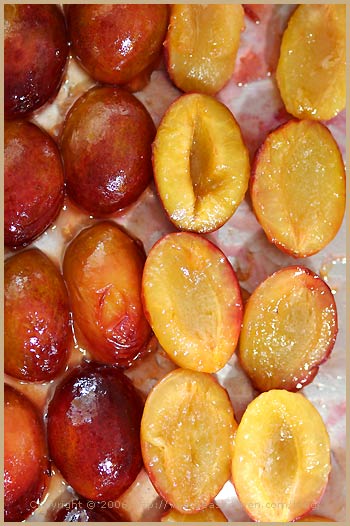
“I have eaten” begins the poem, a phrase appealing to all gourmands, arousing our curiosity before the next line tempts our eyes, our tongues, our touch: “the plums.” As the poem unfolds, we learn this fruit is “delicious / so sweet / and so cold.”
In “This Is Just To Say” by William Carlos Williams, 28 words in twelve lines say much about taste, sensuality, desire, temptation, contrition, impatience, hunger, and satisfaction. [Copyright forbids my quoting the whole poem here, so please read it at the Academy of American Poets.]
Our speaker speculates that the recipient of the message is “probably / saving / for breakfast.” The time of the poem might be night or early morning if the next meal for which the plums are “probably” being saved is “probably” breakfast. Are we reading a note on the door of the refrigerator, or are we overhearing a spoken voice, perhaps a confession to the person who has discovered our speaker standing in the kitchen, cheeks flushed and fingers dripping juice, or a whisper in the ear of a sleeping lover?
The word “delicious” is decisive, stretching over the tenth line like an outreached hand. The fruit, both “sweet” and “cold” was too tempting and was worth whatever penance the speaker will be asked to pay, perhaps expects with “Forgive me.” Our speaker likely seeks understanding, not punishment, hoping the person who chilled the plums will empathize with such temptation of the senses, the fruit irresistible but not clearly forbidden, the pleasure like the language of the poem, so simple and “so sweet.”
Perhaps our speaker says “Forgive me” at the beginning of the last stanza to acknowledge the sin of gluttony after eating more than one plum—after eating all the plums though we don’t know how many except the plural word meaning multiple—and hasn’t saved even one for the person to whom the apology is addressed. Too hungry! Too tempted! And ultimately satisfied or satiated.
The single sentence of this poem has no terminal punctuation, no official ending except for the absence of any other word after “cold” in the final line. Was the speaker discovered mid-bite of the last plum? Was the sentence interrupted by a slap, a kiss, or a healing touch? The gentle rhythms and soft syllables of the poem, like ripe plums, invite speculation (“probably”) and suggest satisfaction (“delicious”), a tribute to the sensory and sensuous, especially the sense of taste.
William Carlos Williams (1883-1963) “sought to invent an entirely fresh and singularly American poetic, whose subject matter was centered on the everyday circumstances of life,” according to his biographical sketch at the Academy of American Poets. Among these subjects were sharp visual portraits that suggested the very nature of objects and the richness of meaning surrounding them. He was also a practicing physician, a man who knew about the healing powers of the ordinary, like temptation, forgiveness, and ice-cold plums.
Google offers more than 130,000 images for plums. To complement “This Is Just To Say,” I am particularly drawn to the photograph above accompanying a recipe for Plum Clafoutis from Béatrice Peltre at her blog, La Tartine Gourmande.
Your response to this poem and post and your own favorite culinary poetry are welcome here.
- posted by Donna Reiss
Thursday, January 3, 2008
Ethics for Dummies
The following comes from an e-zine posted by the food and travel writer David Rosengarten (www.davidrosengarten.com) last fall. His advice made me cringe (I have highlighted the most egregious statement):
People on the Road Don't Take You Seriously in Your Quest for Authentic FoodDo whatever it takes--but make it clear to restaurateurs, or to people from whom you're seeking restaurant advice, that you want the real thing! Initially, you may have trouble getting anything at all. A few years back, I led a group of Americans on a gastronomic tour of Thailand. We arrived late Saturday night and went to bed champing at the bit to taste Thai food in Bangkok. When we boarded our tour bus the next morning, we asked our Thailand guide, who knew full well we were a gastronomic group, where lunch was going to be. "Well, during lunchtime we're going to a jewelry workshop," she said. "If you want lunch after that, back at the hotel you can get anything you want."
There's a whole world out there just itching to ignore you when you say, “I want to taste authentic local cooking." That's why you have to repeat it over and over again, like a mantra. If the person you're talking to speaks reasonable English, explain your quest in detail, supplying the emotional history behind your need. Make an impression. Lie if you have to; tell him or her that you're a journalist, on assignment to taste the real food of the country.
Sensing trouble, I said, "Most of us would rather skip the jewelry and go to an authentic Thai restaurant for lunch." She looked perplexed, then said, "Thai restaurants aren't open for Sunday lunch." This contradicted what I'd read in my books, but I couldn't budge her. Finally, amidst the beautiful temples and pagodas we were visiting in the morning, I managed to get a consensus from the group: everyone in it was willing to boycott the tourist-trap jewel shop and to set off with me looking for lunch. When I told her, she caved. "Okay," she said, "I'll take you to a place I know." She did, it was fabulous, and our trip was off to a great start. Had I not persisted, however, my first meal in Thailand might well have been southern fried chicken.
Something else frustrated us in Thailand, as it does in all countries with spicy-hot cuisine: they never trust that Americans like it hot. Once again, you have to say over and over: "Please serve us the food exactly the way you like to eat it. We like really spicy food." I was a dinner guest once in Goa, one of India's spiciest regions, at a private home; despite my letters to my hosts, the letters of the travel agency that set the dinner up, and the exhortations of our local tour guide (whom I lectured in advance of the dinner about my desire for authentically spicy food)--well, you guessed it. The food had not a lick of spice in it, and many of the dishes were Americanized versions of the local food. This was a meal to introduce me to Goan food--and there wasn't even any vindaloo on the menu. When I discreetly inquired about vindaloo, they said, "Vindaloo? Oh, you wouldn't like vindaloo." Aaaargh!
One reason this happens is that people in foreign countries want you to like them--and their food. It's not hostility that's messing up your quest--it's ill-placed niceness. Remember that all they know of American food may be McDonald's, and they can't begin to imagine that you really want something else. It's your job to convince them!
Once, I was on a wine writers' trip in northern Italy, and we were given a lunch at one of Italy's largest wineries. Food-wise, they did well; they prepared a wonderful meal featuring local cuisine, including a hand-rolled pasta called bigoli that I shall never forget. We couldn't wait to see what they drink with bigoli in the region--so our jaws (and spirits) dropped when they served us an American Chardonnay. "We just acquired this American winery," they told us, "and we thought you'd love to taste something from your own country." Don't they get it? No, they often don't. Remember that.
Another factor that mucks up your quest for authenticity is the internationalization of food and your host's well-intentioned desire to show you what he or she considers to be the most up-to-date cooking of his or her region. Unfortunately, today, the most "impressive" restaurants in some regions are fusion-confusion, one-world kind of deals. I'll never forget arriving in Vigo, a lovely town in Galicia, in northwest Spain, with the largest fish market in Europe and a great tradition of Gallego seafood cooking. My hosts promised me that dinner would be at the best restaurant in Vigo, and I couldn't wait to get myself around those local shellfish specialties. I couldn't believe it when I wound up at a place that was serving foie gras with a fruit sauce, fish fillets with potato scales, and beef tenderloin with a wine sauce. And, oh yes, crème brûlée. The locals didn't realize that you can get this kind of food in any city in the world today. For them, truly, this restaurant was a big deal--something new, something cutting edge. For me, unfortunately--despite the sweet people I was with--it was a big drag. Be careful! Be clear about what you're looking for! Remember the mantra: "I want to taste authentic local cooking! I want to taste authentic local cooking! I want to taste authentic local cooking!" Sometimes I feel like wearing a badge with those words on it. Translated into local dialect. Oftentimes you need it. –end--
My comment:
I don’t have a problem with anyone seeking out local cuisine — just don’t lie about being a food journalist! We don't muscle into a country and demand special treatment. You’re a guest in that country. It is your job to be polite, learn their customs and make friends with a trusted local source. Organizations such as the Association of Food Journalists have strong codes of professional standards and ethical conduct. Rosengarten's instructions are an insult to working journalists covering food and any other subject.
--Patty LaNoue Stearns, Traverse City, MI, food and travel writer
